Showing posts with label Abuses of literature. Show all posts

Monday, June 7

Time's arrow

'And I within, who came at the wrong time - either too soon, or after it was all too late.'
- Time's Arrow

'...fuck you and fuck this stupid club…’

*********************************

Dear Mr. Smith,

I’m writing to you to tell you about my son, Luke.

He is currently playing for Stalybridge Celtic in the Conference North, but I truly believe that he has the ability to play at a higher level, having played for Lincoln in the football league and York in the Conference. Luke was a trainee at Sheffield Wednesday, and I’m sure you can talk to some people there who will tell you about him, but if you were to offer him a trial, you’d see a strong central defender who will give his all for Oxford, but also knows how to play a ball.

*********************************

‘…I am so proud. It's great to get the award from the lads, but to receive the supporters’ award as well is fantastic and I'd like to thank them for that. I wasn't in the team at the start of the season but was determined to do everything I could when I got my chance, and that seems to have paid off. I'll be taking the trophies home in the summer to show my family, and they will take pride of place…’

*********************************

Luke is desperate to play for Oxford under you, and should he get a chance to show what he can do, you will be getting a fully-committed professional footballer. All Luke wants to do is be the best footballer he can be, and playing for a manager of your experience would enable him to do this.

*********************************

‘…Fozzie has been disappointing in his attitude, which has affected why he's not involved. Lifestyle is very important for a footballer and he maybe needs to look at changing his…’

*********************************

Yours sincerely,

Mr. Foster

*********************************

‘…He's played for Lincoln and York and I got a letter from his dad - it's probably because he's a Sheffield lad that I took a bit of interest in him. And I spoke to Marvin Robinson, who played with him at Lincoln. He said that he crunches people - so I thought that might do us well in this league!..’

[Image credits: sand adapted from a photograph by Manfred Morgner courtesy of the Wikimedia Commons; Images of Luke Foster courtesy of Steve Daniels/Rage Online, and reproduced here with kind permission]

Saturday, May 8

Journey to our heart of darkness

'There were moments when one’s past came back to one, as it will sometimes when you have not a moment to spare to yourself; but it came in the shape of an unrestful and noisy dream...'

- Heart of Darkness

Going to the ground that day was like travelling back to seasons past, when supporters crowded the bars and clustered round the stadium. Yet, like a visit to the past, a silence seemed to lie over the area. An as-yet-empty terrace, a great silence, and impenetrable crowd of people. The air turned cold, time slowed. When the clouds occasionally parted, there was no joy in the brilliance of the sudden sunshine. The meandering groups of supporters who had stayed with us for the whole journey wandered into the gloom of over-shadowed distances, eyes cast down, avoiding the excited glances of others who had just joined us now.

You lost your way that day as you would in a desert, and batted all day long against shoulders, trying to find your way through, till you thought yourself bewitched and cut off for ever from everything you had known once – somewhere – far away – in another existence perhaps.

There were moments when one’s past came back to one, as it will sometimes when you have not a moment to spare to yourself; but it came in the shape of an unrestful and noisy dream, remembered with wonder amongst the overwhelming realities of this strange world of faces, and grey, and silence. And this stillness of life did not in the least resemble a peace. It was the stillness of an implacable force brooding over an inscrutable intention. It looked at you with a vengeful aspect. I got used to it after a while; I did not see it any more; I had no time. The game started and I had to keep guessing at our course; I had to discern the dangers that lay ahead, the signs of mistakes; I watched for a moment of inspiration to visit the players in yellow in front of me; I was learning to clap my teeth smartly before my heart flew out when a speculative shot would stray towards our goal, only to be gathered safely in. When you have to attend to things of that sort, to the mere incidents of the surface, the reality – the reality, I tell you – fades. The purpose for our journey, the inner truth, is hidden – luckily, luckily. But I felt it all the same; I felt often its mysterious stillness watching us after we’d paid the entrance fee, not to forget the heartache which makes up the rest of the price.

But what, indeed, does the price matter, if the trick is well done?


[Image credits: Image from Apocolypse Now courtesy of the Wikimedia Commons; match image courtesy of Steve Daniels/Rage Online, and reproduced here with kind permission]

Thursday, February 18

Our dark material

'This strange hulking presence gnawing its meat was like nothing she had ever imagined, and she felt a profound admiration and pity for the lonely creature.'

- Northern Lights

‘Beast. May I speak to you?

My heart was thumping hard, because something in the Beast’s present made me feel close to coldness, danger, brutal power, but a power controlled by intelligence; and not a human intelligence, nothing like a human. The tattoos that snaked down his arms seemed to wreath his limbs with some organic design. This strange hulking presence pounding the touchline of the pitch was like nothing I had ever imagined, and I felt a profound admiration and pity for the lonely creature.

He ceased his pounding and crouched. Steam rose from his close-cropped head, and his stubble-lined jaw tightened. Then he stood up massively, six feet and more high, as if to show how mighty he was, to remind me of how useless the advertising hoardings would be as a barrier, and he spoke to me from that height.

‘Well? Who are you?’

His voice was so deep it seemed to shake the earth.

‘I’m a supporter of Oxford United.’

‘What do you want?’

‘I want to see you employed.’

‘I am employed.’

It was very hard to detect any expressive tones in his voice, whether of irony or anger, because it was so deep and flat.

‘Employed at what?’

‘I train with the team.’

‘What kind of work is that for a player such as you?’

‘Paid work.’

The beast knelt and began to stretch his mighty legs, heedless of me, it seemed; but then he spoke again.

‘What work are you suggesting?’

‘Fighting, in all probability,’ I said. ‘Soon we have to play Wimbledon at home, and Stevenage away. When that happens, we’ll have to fight to win.’

‘And what will you pay?’

‘I don’t know what to offer you Beast. If honour and glory are desirable to you, I can offer that.’

He was silent.

‘Forgive me for asking, Beast, but you could live a free proud life on the pitch. What ties you to the touchline and the bench?’

I felt my skin shiver all over. The question, which was almost an insult, may have enraged the great creature beyond reason, and I wondered how I’d had the courage to ask it. The Beast stopped his stretch, and came close to the terrace where I stood to peer at my face.

‘I know Stevenage and I know Wimbledon. Now I don’t like these teams, so I shall answer you politely. I stay here and pace this touchline and sit on that bench because they took away my yellow shirt. Without the yellow shirt I can train, but I can’t go to war in matches such as you speak of. I came to Oxford to escape from this league with you, and battles such as these are the air I breathe and the food I eat. They took my shirt from me, and if I knew how to get it back, I should tear that bench from its fixings and hurl it into the stands. If you want my service, I must have this shirt. With that, and I shall serve you in your campaign, either until I am dead or until you have victory.’

With that, I watched the mighty beast turn and resume his ceaseless patrol of the touchline, his eyes focused on something in the distance that before I had not been able to discern. But now I knew that it was a yellow shirt with the Ox's head above the ford on its chest.

[A post in honour of Mark Creighton's service to Oxford this season. Rhys Day and Jake Wright have formed a formidable centre back pairing, and one couldn't argue with that. But in the same way that we wouldn't contest the fox hunting ban, nevertheless the sight of Mark Creighton playing for his place in an FA trophy game seems as sad a sight as a pack of hunting dogs chasing a bag of sand.

Image credits: Image of polar bear adapted from a
photograph by douglasperkins courtesy of the Wikimedia Commons; images of Mark Creighton courtesy of Steve Daniels/Rage Online, and reproduced here with kind permission]

Saturday, January 2

Romulus and Remus

'To antiquity we grant the indulgence of making the origins of cities more impressive by commingling the human with the divine, and if any people should be permitted to sanctify its inception and reckon the gods as its founders, surely the glory of the Roman people in war is such that, when it boasts Mars in particular as its parent and the parent of its founders, the nations of the world would as easily acquiesce in this claim as they do in our rule.'
- The Rise of Rome

1. How this new age of Oxford was founded is not agreed amongst observers: for while many great players were present for some time before the dawning of this age, yet they could not then acquit themselves with true honour on the field of play. 2. Perhaps the reason which should be given the widest credence is the meeting of the brothers-in-arms; Clist and Bulman.

3. Some are suspicious of the fictitious and fabulous qualities of this story: how the brothers were found cast out in the wilderness of forests green or reduced to crawling on their belly for scraps. 4. Yet we should not be incredulous when we see what a poet fortune sometimes is, and when we reflect that this new age of Oxford would not have attained to its present power, had it not been of a divine origin, and one which was attended by great marvels. 5. That they were suckled by a she-wolf in the shade of a wild fig tree would scarce be believed, until we reflect on their qualities: the ferocity of Bulman, or the cunning of Clist. For the noble size and beauty of their bodies betokened their natural disposition, and when they achieved adolescence, they were both of them courageous and manly, with spirits which courted apparent danger, and a daring which nothing could terrify. 6. But Clist seemed to exercise his judgement more, and to have political sagacity, while Bulman’s strength and ferocity ruled his nature.

7. Historians have long debated the greater of the two.

8. To the observer first sighting the pair in battle, it is Bulman whose demeanour draws the eye. Tenacious and ferocious in his tackling, harrying his opponents wheresoever they are to be found, his fearsome prowess in the centre of the fight is seared into the mind for friend and foe alike, as when he fought all comers from Stevenage. 9. Yet where Bulman clears the way, it is Clist who prepares the attack for Oxford, his passing drawing his fellow men into the fray, and occasionally joining the raid himself, penetrating his opponents’ defences with his cutting runs, and unleashing volleys from distance to their dismay.

10. Were they to clash, as Romulus and Remus once did to decide the direction of the people they led, who would prevail to lead our new empire? 11. According to one account, Bulman is destined to embody the spirit of the club, the Bull of his name answering to the Ox of ours. 12. But it is impossible to say. Whereas it is known the world over what glory accrued to Rome once Romulus prevailed in his quarrel with Remus over the founding of Rome following his mendacity, the truth is that Clist and Bulman’s glory is entwined in their very partnership in the heat of battle; and to separate the two is to sow the seeds of turmoil for Oxford. To remove Clist would be to lose our guile that undoes the enemy; to remove Bulman would to see this guile smothered by the barbaric hordes of those who would oppose this new age of civilisation.

[Image credits: Images of Romulus and Remus by Giovanni Dall'Orto (photograph of the Fountain in Piazza del Campidoglio (Rome) and Rubens courtesy of the Wikimedia Commons; images of Danny Bulman and Simon Clist courtesy of Steve Daniels/Rage Online, and reproduced here with kind permission]

Thursday, November 5

Sammy dans la Stade

"'Don't give a damn, what I wanted was to go in the Metro.'"
- Zazie in the Metro

‘Howcanitstinkso?’ wondered Sammy. The bus doors open and Sammy skipped from the steps onto the pavement. He looked around: nothing was happening. Spotting the fludlites between the towerblock and rooftop, he weeves across the road and into the estate opposite. Here, likewise, there seemed to be nothing happening. A man across the street unloaded shopping bags from his car; Sammy skims round the corner. A path and a bridge across a dribble of a river, and Sammy discovers the objective of his excursion: the stadium rises up in front of him.

Sammy scuffs his heels as he starts to walk round the ground, glancing through the mesh doors and pondering. Unzipping the holdall on his shoulder, he scoops a football out and up into the air, before starting to gently kick it from foot to foot as he ambulls along. Lost in the pleasure of this, he rounds the corner and heads towards the glass eddyfizz before him.

It was then that Sammy noticed the white piece of paper taped above a window in a wall, inscribed in inkjet: ‘OXFORD vs. THURROCK FA CUP EAST STAND TICKETS £12’. The ball dropped to the flaw, and rolled away. Approaching the sign, throat dry with emotion, Sammy stood, re-reading.

His study of the paper was interrupted as a man approached.

‘Alright Sam.’ says the man.
‘Alright.’
‘Back then, are you?’ asks the man. ‘How was Nooport?’
‘(gesture)’
‘There’s a training ball here.’ says the man, bending down to pick up Sam’s football.
‘Znot a training ball, zmine.’ says Sam.
‘You know we’ve got plenty of footballs here.’ Laughs the man.
‘I like having one to kick.’ shrugs Sam.
‘(gesture)’
‘Home cup game then,’ says Sam. ‘when’s the team anownsed?’
‘Already is. Sheet sup.’

Sam grabs his ball, stuffs it in his bag, and barrels into the stadium through the glass doors. Round the corner through the corridor past the office round another corner to the office on the right, flies to a stop in front of the notisbored and the printed sheet. Starting from the top, he reads down, and further down, past the heading ‘Subs’, until his eyes finally alight on ‘Deering, S.’. He stares. And stares. Before finally he turns back the way he came, ball at his feet, playing one-twos with the wall, lost in a daze. Finally back.

A door slams.

‘Nofuckingfootballsinthefuckingcorridors!’

‘Sorryboss’, calls Sammy over his shoulder, feet still attached to the ball, thoughts deflected, passing over cross-field balls and shots from outside the box.

[Picture credits: Top photo cropped from a photo by Jean-Alexis Aufauvre, courtesy of the Wikimedia Commons; Images of Sam Deering courtesy of Steve Daniels/Rage Online, and reproduced here with kind permission.]

Thursday, September 3

After the return of the prodigal son

‘I gave them happiness, but I was not so self-serving as to let them forgive me. Not quite, not yet’
- Atonement

I’ve been standing at the mouth of the tunnel, feeling the waves of post-match fatigue wash over me, as I look at the penalty area in front of the East Stand. Thinking of goals from the last few weeks; thinking of goals from two years ago.

It’s been a month now, a month of trying to do what I’ve wanted to do for some time. Not to go back to that time two years ago, although I would be a liar if I were to deny I would do it if I could, but to find some kind of atonement for what came after.

The problem for this month has been this: how can a footballer achieve atonement for the past when forgiveness seems to only live in the present, so fleetingly? How many of these moments must there be before there can be atonement? The supporters may forget the past in the moment I score a goal, but can they ever really forgive? As the euphoria dies, is there not a look that tells me they can’t quite give themselves entirely to the moment - not yet - as I once didn’t give myself to them?

Perhaps it was always an impossible task, and perhaps that is precisely the point. The attempt was all. I can give them happiness, but I am not so self-serving as to let them forgive me. Not quite, not yet.

If I have the power, I would conjure them at a promotion party in April… a spring day at Minchery, milky sunlight slanting across the pitch, the supporters, jubilant in the stands, a sea of yellow as we confirm the championship? It’s not impossible.

(The images of Matt Green in this post are courtesy of Steve Daniels/Rage Online, reproduced here with kind permission.)

Friday, May 1

Last night I dreamt I went to Minchery again

‘We can never go back, that much is certain. The past is still too close to us.’

- Rebecca

Last night I dreamt I went to Minchery again. It seemed to me, as I stood in front of the locked gates to the ground, that I could not enter, for the way was barred to me. Then, like all dreamers, I was possessed of a sudden with supernatural powers and passed like a spirit through the barrier before me.

The passage closed around me, cloistering me from the moonlight as it once had the sunlight, the air inside cooler and still. The blotched and stained concrete echoed slightly to my soft steps as I followed the way round to the left, past the shelves now empty of wrappers and bottles. Darkened doorways to booths and toilets and shuttered refreshment bars bore silent witness to my passage. The breeze blocks and sandy cement felt rough to the touch as ever, cold under my fingers. Signs that once guided now seemed to loom over me, their intentions redundant and unclear. I hurried through the shadows toward the pool of moonlight in front of me.

And then I turned to my right, and there was the pitch - our pitch - silent and suggestive as it had always been. A torn square of blue paper, missed by the groundstaff, scuttled past my feet, blown by a sudden breath of wind, and made for the darkened grass.

Moonlight can play odd tricks upon the fancy, even upon a dreamer’s fancy. As I stood there, hushed and still, I could swear that the ground was not empty, but lived and breathed as it had lived before. A slight sigh of wind ruffled the grass, and I saw the forms so familiar to me, in formation to take a free kick from the corner. The wind seemed to collect as a voice that cried out to them. A figure drove the ball low across the box, a foot connected with it, and it flew through a crowd and into the back of the goal. Figures wheeled away, seeming to revel in a sense of invincibility, others rushed to collect the ball, and from the privileged position of the dreamer, I saw the inexorable momentum of inevitable victory, certain as it had been many times before.

A cloud, hitherto unseen, came upon the moon, and hovered an instant like a dark hand before a face. The illusion went with it, and the figures disappeared. I looked upon a desolate shell, soulless at last, unhaunted, with no whisper of the past about its staring terraces.

[Some editorialisation that we usually try to avoid too much of:

For this piece we borrowed from our ‘inspiration’ even more so than usual, so if you liked some of that, you can probably be sure it was lifted pretty much straight from
Rebecca, and we should make the debt to Daphne du Maurier even more explicit than we usually do for writers we use. It’s the close season: why not
read or watch her story? It’s a dark, thrilling, some might even argue modernist, take on the romantic novel. And it seems appropriate to end our coverage for this season on a dark note for a romantic story, because that’s what we just witnessed. There is one more thing we might post here, but to be honest, the ending of the above piece reflects the way we feel right now: those of us who have followed this unlikely story through the season have been robbed of the chance to see if the most romantic of endings might yet have come about.

And the past is too close to us.

So, we’ll see you all
at Court Place Farm again in a few months no doubt. The blog was intended as a one-season experiment. What was planned isn’t quite what we ended up doing, but we’ve enjoyed it, and so long as we feel we’re not repeating ourselves, there’ll be more. In the meantime, we’ll be making a few cosmetic changes over the summer, but mainly spending our time hoping to read and see interesting things. If you fancy doing the same and would like some ideas, then anything you’ve read on here and liked over the season was inspired by/pilfered from somewhere – search for the title after the quote at the start of the piece, or follow the links to our sources for the art.]

Monday, April 20

Head down, James Constable charges

‘It was to this workman that the strong barytone belonged which was heard above the sound of plane and hammer singing –

‘Awake, my soul, and with the sun
Thy daily stage of duty run;
Shake off dull sloth ...’’
- Adam Bede

The afternoon was cold, the cut of freezing air bit as James Constable looked round the pitch, dappled in dying afternoon sun, the Altrincham players preparing to face the goal kick. Close-cropped hair suggested a man for whom labour came before appearance, his face lean to his bones. While his brow was somewhat furrowed, the intent gaze betrayed concentration, not puzzlement.

A release of breathy steam formed in front of him as he paused: a moment of measurement required. For James Constable, a football match was not a work of art, but one of labour. It was to be worked at, the defence tested, gradually worn down. The defence was to be respected - its nature must guide the craftsman, direct his efforts; but, unstinting, he must bend the material at hand to his will.

It is only by working at the opposition that the craftsman starts to feel its knots and grains; where it will hold, where it is weak; where to apply the plane, and where the chisel. The ball must be chased to the corners, the goalkeeper’s claims contested, the centre halves' strength tested, the full back’s resolve checked. Gradually the shape of the task in hand becomes clear, and the finishing touches can be applied, before the craftsman can stand back to survey his work, wipe the sweat from his brow and the dirt from his body, and leave for his evening’s rest.

Perhaps there is such a thing as an artist; perhaps instinct can create something beautiful in a moment; perhaps inspiration can see what no one has seen before. Perhaps. But for the vast bulk of mankind, we are told one from the other by our endeavour, honesty, and toil.

James Constable stood back to survey the progress of his work so far. Great drops of sweat fell like blood from his shaved head as he shifted his weight back slightly. Heaving the fierce-sharpening air into his lungs once more, he watched the ball begin its driven flight forward to the opposition defence one more time. He picks the point at which to work, and dropping his head, pushes himself into a run once more. Head down, James Constable charges.


[Picture credits: Millet's L'homme à la houe and The Wood Sawyers courtesy of the Wikimedia Commons; Images of James Constable from Steve Daniels/Rage Online, reproduced here with permission; Youtube video courtesy of 'Deddington Steve'.]

Wednesday, April 1

Of Miracles

[So, George Eliot still hasn’t delivered her piece (pull your finger out George, we’re terrified Constable will sign for someone else and we’ll be left with another gap in our, er, hectic publishing schedule), but we have more pressing matters to consider: the possibility that miracles might happen. As Oxford United have produced an incredible run of results, yet need a set of seemingly miraculous events to converge in order for anything to happen for them this season, We Are Oxford United considers this a topic of the utmost urgency. Where is the Oxford Mail on this?

We needed an expert on the subject, and more importantly, one who could turn in their copy sharpish. Step forward noted Scottish Enlightenment philosopher and critic, David Hume. This is a man who, when his first book ‘fell dead-born from the press’, simply chopped it in two, re-edited it, and published it as two books - which promptly took the 18th century coffee houses by storm. Now that’s the sort of writer We Are Oxford United could get on with. So, we’ve asked Hume to consider, on the principles of his famous consideration of miracles, whether or not Chris Wilder (m’Lord) is the next messiah and can bring miraculous events to the county of Oxfordshire, or whether we need to be awoken from our dogmatic slumbers.]

It is strange a judicious reader is apt to say, upon the perusal of these wonderful histories, that such prodigious events never happen in our days.

- An Enquiry Concerning Human Understanding

A wise man proportions his belief to the evidence. In such conclusions as are founded on an infallible experience, he expects the event with the last degree of assurance, and regards his past experience as a full proof of the future existence of that event. In other cases, he proceeds with more caution: He weighs the opposite experiments: He considers which side is supported by the greater number of experiments: to that side he inclines, with doubt and hesitation; and when at last he fixes his judgement, the evidence exceeds not what we properly call probability.

To apply these principles to a particular instance; we may observe, that there is no species of reasoning more common, more useful, and even necessary to human life, that that which is derived from the testimony of men, and the reports of eye-witnesses and spectators. Yet we frequently hesitate concerning the reports of others. We balance the opposite circumstances which cause any doubt or uncertainty; and when we discover a superiority on any side, we incline to it; but still with a diminution of assurance, in proportion to the force of its antagonist.

I should not believe such a story were it told me by Jon Murray was a proverbial saying in Oxford, even during the lifetime of that venerable historian. The incredibility of a fact, were it allowed, might invalidate so great an authority.

The Oxford supporter, who refused to believe that United could win away at Crawley, reasoned justly; and it naturally required very strong testimony to engage his assent to the facts, that arose from a state of nature, with which he was unacquainted, and which bore so little analogy to those events of which he had constant and uniform experience. Though Oxford winning at Crawley was not contrary to his experience, it was not conformable with it.

But now let us suppose that a fact, which witnesses affirm, instead of only being marvellous, is really miraculous; and suppose also, that the testimony considered apart and in itself, amounts to an entire proof; in that case, there is proof against proof, of which the strongest must prevail.

A miracle is a violation of the laws of nature; and as a firm and unalterable experience has established these laws, the proof against a miracle, from the very experience of the fact, is as entire as any argument from experience can possibly be imagined. Thus no testimony is sufficient to establish a miracle, unless the testimony be of such a kind, that its falsehood would be more miraculous, than the fact which it endeavours to establish.

When anyone tells me that that he saw a dead man restored to life, or that their football team has turned around an appalling run of form over a half a season to achieve promotion, I immediately consider with myself, whether it be more probable that this person should either deceive or be deceived, or that the fact, which he relates, should really have happened. I weigh the one miracle against the other, and according to the superiority, which I discover, I pronounce my decision, and always reject the greater miracle. If the falsehood of his testimony would be more miraculous, than the event which he relates; then, and not till then, can he pretend to command my belief or opinions.

I am better pleased with the method of reasoning here delivered, as I think it may serve to confound those dangerous friends or disguised enemies to the Commonwealth of Oxford United, who have undertaken to defend it by the principles of human reason. Our most holy cause is founded on Faith, not on reason; and it is a sure method of exposing it to put it to such a trial as it is, by no means, fitted to endure. To make this more evident, let us examine the miracles, related in what Oxford need to do for the rest of the season, and we shall examine it according to these pretended supporters, not as the testimony of God or Fate itself, but as the mere production of probability.

Here then, we are to consider a story, presented with no corroborating facts, which many football teams claim as a past myth. Upon hearing it, we find it full of prodigies and miracles. It gives an account of a football team entirely different from the first half of the season: Of dominant home performances: Of determination unseen by men in yellow: Of not only points gained away from home, but on many occasions three; at places such as Crawley, Kettering, and Rushden: Of a consistency of success such that so few points dropped they may be counted on one hand: Of a striker with a goalscoring record of more than 20 in a season: Of not just one rival team falling away at the vital moment, but many: And of a team who do not allow the pressure to affect their performances. I desire any one to lay his hand upon his heart, and after a serious consideration declare, whether he thinks that the falsehood of such a story would be more extraordinary and miraculous than all the miracles it relates.

Yet of course, our most holy religion of Oxford United is clearly attended with miracles, and we may conclude that mere reason is insufficient to convince us of its veracity; And whoever is moved by Faith to assent to it, is conscious of a continued miracle in his own person, which subverts all the principles of his understanding, and gives him a determination to believe what is most contrary to custom and experience.

[Details from images of Christ's Ascension from the Rabula Gospels and of 'The Resurrection of Lazarus' by Bonnat, courtesy of the Wikimedia Commons.]

Thursday, February 26

The methadone metronome

[Ed.: In a radical move to reposition ourselves from an odd cranny of the internet to ‘content provider’, We Are Oxford United attempted to commission a match preview for Oxford’s game on Saturday against Torquay, which is being broadcast on Setanta from 5.45. The process was an experience of such drawn-out frustration that I can’t promise the experiment will be repeated, but given the amount in fees and expenses that we paid for this piece, we might as well run with it.]

'...what kind of sick and twisted impulse would cause a professional sportswriter to deliver a sermon from the Book of Revelations off his hotel balcony on the dawn of Super Sunday?'

- Fear and Loathing at the Super Bowl

‘Jesus, I’ve been stuck in this breeze block disaster on the edge of Oxford for a day now, with this goddamn blog editor busting my balls for 500 words. On football for crissakes. Non-league football. ‘Holiday Inn’ my goddamn ass.

For reasons I’d rather not go into right now, these 500 words are going to need to get written tonight, and my expenses have been spent in the pitiful excuse for a bar downstairs, getting angrier and angrier. Now I’m staring out at the soft orange light that’s trying to suffuse the three-sided hulk across the car park from my window. By my side is the three-quarter drunk remnants of what I could prise from the barman, and I’m thinking that I can’t be here at the weekend for this game.

How did this football club get into this mess? Non-league football is mostly terrible, we know this, but if the appeal isn’t the ‘football’ of FC, it’s meant to be about the ‘club’ part – something bigger than eleven men on a pitch. That’s what this swine of an editor tells me he wants. The things that keep supporters following their team if they’re not paying to watch eleven ball wizards break the laws of physics in a premier electric-superdome. I should have a story here about terrace camaraderie, about the players who grew up watching from the stands the team that they now play for. But I’m just getting depressed here. Depressed and angry.

This outpost of sport has the worst of both worlds. Tomorrow, two teams of footballers who never made it or probably never will (honest journeymen and local young hopefuls these notes say), will compete. But where’s the experience of football at its simplest? Where are these Halcyon Days? I’ve seen tapes of these televised games: Games played on Friday nights, Sunday afternoons – Jesus - Thursday nights? Players can’t put their asses on the substitutes bench without being interviewed. Kick-offs timed to accommodate stunts involving giant foam square creatures. Second-rate presenters, exuding the violent mix of failed dreams and desperate eagerness, trying to imitate the vacuousness that has been perfected in that bubble of self-reference, the Premiership. The Barclays Premier League, if you please, that’s if Barclays hasn’t been swallowed in the howling vortex that has finally caught up with those bastards in Wall Street (but you know for a fact that the Premier League boards will survive this, as they would probably survive any catastrophic collapse of the ozone layer or nuclear strike that might occur too).

But that’s not what I wanted to write about. What I wanted to say, was that all the time this swill is broadcast, the non-league grounds are half-empty as the option of watching this charade is less painful when you don’t have to move from your sofa. Non-league football has sold what it offered for a pat on the head, a chance to pretend it’s not what it is, and it’s been left with the worst of both worlds. The football is still non-league, still left trying to make up for what it lacks in skill with earnest effort, but fixtures are moved on a whim, driven by the hollow spirit of commercialism which watches over proceedings. The bloodshot eye of the television camera leaches those poor dingbats who are at the games: ‘Look how much this means to them. Look at their innocent joy. Look at the depths of their despair. It’s not even caused by anything important, like Manchester United beating West Brom. We will broadcast this for you! The viewer!’

So I’m not doing this. I need to be on a beach, trying to recover from this trip. Well, that and the fact that I’ve an appointment at a particular Jamaican drinking establishment in town, a place where all this trouble began. Ah… but that is another story, and we don’t have time for it here, so I’m giving that bastard editor these words and he can do what the hell he likes with them.’

[Ed.: Well, it might not be the only reason, but T.V. is one of the reasons why less than ten percent of our county actually goes to an Oxford United game.]


Thursday, February 12

A pause in play

'I think that we communicate only too well, in our silence, in what is unsaid, and that what takes place is a continual evasion, desperate rearguard attempts to keep ourselves to ourselves.'

-Harold Pinter

HP: We could go and see a play.

Silence.

HP: We went to see a play once before.
Pause.
That time when we were over for a game in Cambridge.
SB: Did we so?
HP: Yes! You remember. Freezing. That small chap scored for us. What was his name?
SB: I don’t remember.
HP: You do. Useless bugger most of the time, but he could hit a ball on the volley.
SB: I don’t remember.
HP: Scored about two goals in his whole time with us, but both were absolute crackers.
Pause.

SB: You might mean Rawle.
HP: Was it? I don’t remember.
Pause.
Anyway, we went to see a play.
SB: A play? In Cambridge?
HP: Yes! Come on, you remember. It was when that tall black guy… what was his name… scored in the derby… Louis. Louis was substituted twice! On and off!
SB: That wasn’t Cambridge.
HP: Wasn’t it? The one where Louis was substituted on and off? You must remember. Brainless bugger if ever I saw one. Anyway, he’s brought on in the second half, but blow me if he isn’t worse than useless, and the manager hauls him off again ten minutes later!
SB: It was Bristol.
Pause.
Bristol Rovers.
HP: Rovers? The one where Rawle scored, and Louis was substituted twice? On and off?
SB: Yes.
HP: Bristol? Where Louis was substituted twice?

Silence.

HP: Was that the season they were almost relegated, but they came to our place and won one-nil?
SB: No…
Pause.
That was the season before.
HP: The season before. They came to our place and won one-nil. Bloody useless they were, but that bugger from Wycombe… what was his name?..

Silence.

SB: Rammell.
HP: Rammell! That bugger from Wycombe, Rammell, scored against us when they hadn’t had a chance all game. Bloody useless they were. Mind you, not as bloody useless as our lot that day. They wouldn’t have been able to have finished their tea.

Silence.

Bloody useless.

Silence.

Just think, if they’d not won then, they might have been relegated. Strange to think of Rovers going through all that, and us with it all to come. It’s strange how things turn out, isn’t it?

Silence.

I suppose you only think of how things look from your perspective at the time. We needed the points to get into the play offs, but they needed the points to stay up, and I couldn’t have given two hoots about it. And there we were, five years later, needing the points to stay up when Orient…
SB: Three.
HP: What?
SB: Three years later.
HP: There we were, three years later, needing a win to stay in the League, and Orient, Orient needed the points to go up. I thought they were all callous bastards, but I suppose it’s all just perspective. Strange how things turn out.

Silence.

Strange what your mind gets to turning over when it’s allowed.

Silence.

Jesus, I wish they’d get a game on. I can’t bear not having a game to go to. What’s it like out there, nice?
SB: The same.
HP: Oh.
Pause.
Do you think they’ll get the game on this weekend?

Silence.

So shall we go and see a play instead then?

Silence.

Come on, we’ve got to do something to fill the time.
SB: We always find something. Something to fill the time.
Pause.
HP: …I suppose we do.

Tuesday, January 6

The struggle behind the masque of Billy Turley

‘Melodrama is perennial and the craving for it is perennial and must be satisfied.’

- T.S. Eliot on Wilkie Collins

THE FIRST NARRATIVE
Contributed by Tendrick Mason

I address these lines to the community of learned and scientific gentlemen at large in order to bring the matter of which I write to the forefront of current scientific debate. I am indebted to a MR. TALBOT late of OXFORD (now, I understand, forced, for reasons of potential ill health, to leave for the warmer climes of MALTA) for bringing this extraordinary case to my attention. Cognisant of my scientific interest in matters of the mind, and learning of my preferred means of passing my leisure time in all manner of sporting pursuits, he recommended that I venture to the fair city of Oxford to observe a gentleman of his acquaintance, a MR. WILLIAM TURLEY, football player.

Arriving at this ancient seat of learning, I was soon transported by coach from the close-walled city streets and tranquil college quadrangles to the very edge of the city. Here, far from the warming tea rooms and book shops, I was greeted by the sight of the arena at which I was to see this game of football, its high walls illuminated here and there by the flickering glow of the lamps, crowds flocking around its feet. My driver refusing to linger in the vicinity, I was pressed to ask a passing gentleman how to secure my entrance to the game. Directed somewhat abruptly to a small, roofed booth, I obtained a ticket, made my way through the boisterous crowds, and eventually took my seat. Somewhat taken aback by the wild-eyed fervour that the prospect of this forthcoming game produced in some of my near neighbours, I remained withdrawn into my great coat, pressed back into my seat. Withdrawn, that is, until the commencement of the game. It was not hard to spot the man I had been brought here to see, and I found myself gradually drawn towards the spectacle on the pitch in front of me.

William Turley was an object that immediately commanded one’s attention on first view of him. Hair stood on end, gesturing constantly to his audience, laughing and joking with team mates and at opponents in equal measure, he seemed a man born to the stage, not the pitch. His amusement appeared to derive from the conviction of his superiority to all men around him. While they strove the one against the other to outpace or outmuscle, William Turley seemed to rise above this, removed from the fray, until he arrived with prescient timing to make an incisive intervention, or produce an ingenious moment of acrobatics to prevent the ball from passing him.

Yet, within minutes we were to witness a change in him so profound, one could only wonder whether this jester of the court, privileged to mock those around him with impunity and perform such amazing feats of dexterity, had disappeared to the wings to be replaced by a raving beast. A shot beat him to pass him and strike the post of the goal, rebound back onto the pitch, and be cleared away by one of Turley’s companions. Suddenly, here was a new man! Raving, pointing, spitting, cursing, he kept up such a stream of invective directed at - his team, his opponents, himself, or a world that dared contradict his understanding? - one knew not which or what.

Transfixed, I watched this transformation unfold repeatedly in front of me during the course of the game, as all the while Turley was driven to ever-greater feats of acrobatics and paroxysms of rage. What could explain this dichotomy that existed in one man?

My mind was drawn back to a tale I had once been told. In old Venice there was said to be a player of the stage who performed with such conviction that audiences were left delighted or shaken. He seemed to exist on the divide between being and becoming, reality and pretence, and such was the mystery of his essence that audiences could not ascertain which side of the divide was his true abode. A reaction of shocked exhilaration betrayed the uncertainty of whether they had watched an actor of exquisite skill or a man beyond the claims of society. Yet I have long-suspected the likely truth was darker yet. Born into the profession and of such long-standing service, the player was no longer sure whether he was Harlequin or Tybalt, nor indeed of the individual mettle of his own character. To perform a juggling trick or to commit murder had for him become equal acts, eliciting as they did equal praise from his audience; and further still the confines of the stage had begun to cease to hold any meaning for him. The masques he wore for his performances now held little distinction for him, no longer noticing whether he wore a hooked nose or not, nor even, when he haunted the colonnades and palazzos of Venice, whether he still wore a masque.

Gentlemen, I now put to you this most mysterious case of Mr. William Turley, gentleman of Oxford, man of masques: who can say what forces drive his comportments, who can say whether we will next see Harlequin or Tybalt?

[The images of Billy Turley in this post are courtesy of Steve Daniels/Rage Online, reproduced here with kind permission. The engraving at the top is from The Pickwick Club in The Writings of Charles Dickens, and is courtesy of the Wikimedia Commons.]
Wednesday, December 10

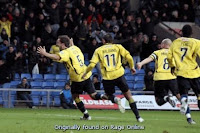
Reading a report on Oxford's draw at Weymouth

'Determined to do exactly what has been asked of him, he painstakingly composes the report in the old style, tackling each detail with such care and aggravating precision that many hours go by before he manages to finish it. As he reads over the results, he is forced to admit that everything seems accurate. But then why does he feel so dissatisfied, so troubled by what he has written? He says to himself: what happened is not really what happened. For the first time in his experience of writing reports, he discovers that words do not necessarily work, that it is possible for them to obscure the things they are trying to say.'
- Ghosts

Weymouth 2 (Beavon 40, 52), Oxford Utd 2 (Day 42, Robinson og 83).

This is the information that confronts him when he returns home. He reads the words quickly, then again with increased intensity, interrogating them for the story he knows lies somewhere behind this data. Confused, unsure whether to react with joy, relief, or disappointment, he tries to make what conjectures he can from the characters in front of him. A point away from home, but against a struggling side. A late equaliser. Two goals for Beavon, once of Didcot. A first goal of the season from Day. But in the end, after speculation, all he can do is stare at the words, reading again and again:

Weymouth 2 (Beavon 40, 52), Oxford Utd 2 (Day 42, Robinson og 83).

Thursday, November 20

One of 3,196 moments

‘My moments, her moments. The dog’s moments.’
- Krapp’s Last Tape

I was there the moment the opportunity went by. I was looking towards the front of the stand at one of the stewards trying to hide his nose in a dirty great luminous coat - glancing in my direction as chance would have it. Our eyes met. Around me a swell grew and I broke from his glance just as the ball passed through the space in front of the goal. For that moment my gaze joined the gaze of players and spectators, fixed on the ball as it moved towards a player’s forehead. But the header ghosted past the post, and the noise subsided, the moment over.

I watched the ball bounce off a chair with a clatter. It lodged itself under another, discounted. Its significance was unclear to me. It might have stayed there, but a child picked it up and threw it back to the goalkeeper.

[Some words occasioned by something Oxblogger wrote.]

Tuesday, October 28

The Desire of James Clarke

‘It’s time to demythologize an era and build a new myth from the gutter to the stars. It’s time to embrace bad men and the price they paid to secretly define their time.

Here’s to them.'
- American Tabloid

When I think about James Clarke, a series of vignettes cross my mind - a flicker of cinefilm story. We’ve watched James Clarke change in front of our eyes.

Click.

March 2007. Stafford at home. A buoyant Oxford crowd watched the ceremony of end of season awards. Optimism in the late spring air. A play-off semi-final around the corner. After a long season in this league it felt like a return to The League would happen after all. The youth team all-conquering - and when the young player of the season was announced, it was a name unfamiliar to most of the crowd.

‘Don’t look so shocked Jamie!’ Peter Rhodes-Brown laughed over the P.A.

What can put this defender ahead of the rest of a talented team? A shy smile. Gentle applause from the crowd. A passing thought as to whether we’ll ever see the boy on this pitch again. And then thoughts returned to the play-offs.


Click.

A cold Aggborough, away to Kidderminster - seven months and a season later. It could have been a lifetime. Still in this league. Still not in The League. A snarling Oxford crowd shut up in one end of the ground - the season spiralling away from them. On the pitch the team clinging on. In the stands men climbing a gantry to bang metal against metal. Willing a campaigning spirit to materialise. The sense of something primal in the air.

And in this atmosphere, James Clarke made his first-team debut.

Oxford defending for their lives. Oxford undeservedly two goals up. The game turns on a contentious sending off. Clarke the player on the ground. The referee adjudged an elbow to have knocked him down. James Constable sent off. Kidderminster incensed. Fingers point. Accusations made. Clarke has feigned the incident. Clarke’s to blame. Cheat. Oxford indignant. The boy’s a young debutant. He’s too young to do that. Too inexperienced. Ranks close. The match a fractious quarrel. Clarke's team mates did what they could to help him through the alley of taunts and studs, spittle and spite.


The final whistle brought relief and victory. The players taking the applause of the fans in the away end - Billy Turley knowing that the acclaim is as much for Clarke’s debut as the team performance. He pushed the young man towards the Oxford supporters behind the goal. Clarke reluctant - shoulder blades shoot back under the pressure of Turley’s shove towards the wall of sound from the terrace.

‘CLARKEY! CLARKEY! CLARKEY!’.

A slight smile. Hands raised briefly to return the applause - then quickly turned and jogged after the rest of the squad. Uneasy in isolation.

‘CLARKEY! CLARKEY! CLARKEY!’.

Click.

The campaigning spirit arrived too late.

Games passed with little purpose. Still in this league. Still not in The League. But amongst this a young defender’s reputation growing. A tackler. A confidence with the ball. But most of all the look in the eye.

And a new aspect to the way he plays?

Burton at home. The winger goes past Clarke. The balled fist goes out - grabbing. The man goes down and Clarke’s game is over.

Innocence and experience?

Click. Click.

July 2008. Court Place Farm. A pre-season game with no edge. But Clarke fighting. Fighting for a place on the team. An unfamiliar left back - but exuded seniority in a second-half team of youth teamers and trialists. And the scales falling from my eyes. His game all pushes and pulls. Shirts. Shorts. Get the man. Stop him. Eyes squinting to see the play. Fingers pointing. Sort them out. No one gets past. Was this always there? Did I choose not to see it? Innocence and experience. Experience from innocence.

Click. Click. Click.

Barrow, away. Oxford kick off another season - still in this league. Still not in The League.

Clarke's fought for and won his place on the team. No innocence. Just experience.

Chest out.

No one. Gets. Past.

The ball falls loose. Get there. The tackle goes in.

Clarke’s game is over.

Click. Click. Click. Click.

A new scene. Hayes in the cup. The game won. No one got past.

The tackle goes in.

Clarke’s game is over.

Click. Click. Click. Click. Click...

Desire drives a boy to become a man. Desire takes him from innocence to experience. Desire makes him who he becomes.

Here’s to the desire of James Clarke.


[Ed.: This piece has been planned for a little while, but it seems appropriate to post it now. Get well soon Clarkey: I see in you the ability, but more importantly the character, to become the sort of man who could define the spirit of an Oxford squad.

All images in this post courtesy of Steve Daniels/Rage Online, reproduced here with kind permission.]

Wednesday, September 17

As I walked out one matchday morning

‘It becomes increasingly easy in urban life to ignore their extreme humours, but in those days winter and summer dominated our every action, broke into our homes, conscripted our thoughts, ruled our games, and ordered our lives.’
- Cider With Rosie

It was a clear morning in September, and the sun was establishing the little grip on the day it would hope to exercise. As I walked along the streets with their close houses toeing the pavement, I scented the sharp cut in the air that comes when Summer finally surrenders the struggle to Autumn, its waste and indifference giving way to acute attention, undercut with the promise of cold.

It becomes easy to ignore, but for those who tramp through this ritual, the seasons have always ruled The Season, with their own marks and measures for these followers. High sulky summer marks the beginning and the end, the early days when you bask in the pleasure of a return to a habit given up, lolling in the activities of matchday, with the luxury of games ahead to make up for points carelessly mislaid in these drowsy days. Winter is the season of anxiety, a sense of something slipping, or something slippery, a just-melting icicle held in mittens, sliding through your grasp before you press your hands together and it flies up almost uncontrollably. Spring is the season when we start to see the signs of growth, the things we will reap according to that which has been sown, before the final few days when we briefly see summer again, and surprise is all too rare.

And autumn: autumn is the season that reminds us that this is to come, that these summer days are over, and we are here again; but that this is not enough, and that there is purpose at hand.

On the way to the ground I paused to take a drink. The pub was a murmur of other football supporters, their folded newspapers, their beer, their darting eyes, and sudden shouts. The pool table was covered, and a pair of policemen completed a circuit of the bar, gloved hands tucked into belts. Laughter came from where the crowd closed again behind them. A solemn-faced man watched his boy scuffle with a friend, before haring between the legs of tables and drinkers. As kick-off time neared, and the bar queue adopted a quiet new urgency, the talk was of games gone and the game to come.

‘Should’ve taken three points last time out.’

‘We’ll do it today, just you see.’

Autumn had arrived, and this talk had assumed a seriousness.