Showing posts with label On the United commonwealth. Show all posts

Wednesday, August 11

Reflections

Not to repeat.

Not to continue to try whatever psychic channel or vibes we seem to have tuned into (The celebration of The Prodigal Son foreseen in September; the future role of York foreseen in October; A voice crying out that the soul of Oxford needed The Beast to return in February... we shouldn't meddle in forces we don't understand).

Not to continue if the flame isn't there. We're there at a rebirth in yellow: Burton-on-Trent bathed in sunshine, our colour around all four sides of the ground. We're there for a Collosseum performance against Bristol. But is the drive there, without the sense of injustice? The planets realigned at Burton. The wrongs were righted that day in May. We look round and see the world is right again. Perhaps this blog was born of that earlier rage, a howl that had to come out somewhere - and now that they've perhaps mellowed?.. well...

We can feel ourselves moving from that Beckettian injunction to eschew the uselessness of words that we wanted to live by. We try again too many times. So of course we continue, but we'll become more sporadic than before... probably more of the Occasional Pen Portraits, the odd Reading Photographs... an image for a match if we feel we've not done it before. We promised not to repeat. Better this way.

Sunday, May 23

Turning town yellow and blue

(A season that didn't end staring at the concrete floor at Minchery, avoiding each other's glances. It ended in the dusk on Broad Street with a hand shake. It feels like we haven't just brought Oxford back into the league, we've brought a real club back to the heart of Oxfordshire.)

Saturday, May 15

Saturday, January 2

Romulus and Remus

'To antiquity we grant the indulgence of making the origins of cities more impressive by commingling the human with the divine, and if any people should be permitted to sanctify its inception and reckon the gods as its founders, surely the glory of the Roman people in war is such that, when it boasts Mars in particular as its parent and the parent of its founders, the nations of the world would as easily acquiesce in this claim as they do in our rule.'
- The Rise of Rome

1. How this new age of Oxford was founded is not agreed amongst observers: for while many great players were present for some time before the dawning of this age, yet they could not then acquit themselves with true honour on the field of play. 2. Perhaps the reason which should be given the widest credence is the meeting of the brothers-in-arms; Clist and Bulman.

3. Some are suspicious of the fictitious and fabulous qualities of this story: how the brothers were found cast out in the wilderness of forests green or reduced to crawling on their belly for scraps. 4. Yet we should not be incredulous when we see what a poet fortune sometimes is, and when we reflect that this new age of Oxford would not have attained to its present power, had it not been of a divine origin, and one which was attended by great marvels. 5. That they were suckled by a she-wolf in the shade of a wild fig tree would scarce be believed, until we reflect on their qualities: the ferocity of Bulman, or the cunning of Clist. For the noble size and beauty of their bodies betokened their natural disposition, and when they achieved adolescence, they were both of them courageous and manly, with spirits which courted apparent danger, and a daring which nothing could terrify. 6. But Clist seemed to exercise his judgement more, and to have political sagacity, while Bulman’s strength and ferocity ruled his nature.

7. Historians have long debated the greater of the two.

8. To the observer first sighting the pair in battle, it is Bulman whose demeanour draws the eye. Tenacious and ferocious in his tackling, harrying his opponents wheresoever they are to be found, his fearsome prowess in the centre of the fight is seared into the mind for friend and foe alike, as when he fought all comers from Stevenage. 9. Yet where Bulman clears the way, it is Clist who prepares the attack for Oxford, his passing drawing his fellow men into the fray, and occasionally joining the raid himself, penetrating his opponents’ defences with his cutting runs, and unleashing volleys from distance to their dismay.

10. Were they to clash, as Romulus and Remus once did to decide the direction of the people they led, who would prevail to lead our new empire? 11. According to one account, Bulman is destined to embody the spirit of the club, the Bull of his name answering to the Ox of ours. 12. But it is impossible to say. Whereas it is known the world over what glory accrued to Rome once Romulus prevailed in his quarrel with Remus over the founding of Rome following his mendacity, the truth is that Clist and Bulman’s glory is entwined in their very partnership in the heat of battle; and to separate the two is to sow the seeds of turmoil for Oxford. To remove Clist would be to lose our guile that undoes the enemy; to remove Bulman would to see this guile smothered by the barbaric hordes of those who would oppose this new age of civilisation.

[Image credits: Images of Romulus and Remus by Giovanni Dall'Orto (photograph of the Fountain in Piazza del Campidoglio (Rome) and Rubens courtesy of the Wikimedia Commons; images of Danny Bulman and Simon Clist courtesy of Steve Daniels/Rage Online, and reproduced here with kind permission]

Wednesday, April 1

Of Miracles

[So, George Eliot still hasn’t delivered her piece (pull your finger out George, we’re terrified Constable will sign for someone else and we’ll be left with another gap in our, er, hectic publishing schedule), but we have more pressing matters to consider: the possibility that miracles might happen. As Oxford United have produced an incredible run of results, yet need a set of seemingly miraculous events to converge in order for anything to happen for them this season, We Are Oxford United considers this a topic of the utmost urgency. Where is the Oxford Mail on this?

We needed an expert on the subject, and more importantly, one who could turn in their copy sharpish. Step forward noted Scottish Enlightenment philosopher and critic, David Hume. This is a man who, when his first book ‘fell dead-born from the press’, simply chopped it in two, re-edited it, and published it as two books - which promptly took the 18th century coffee houses by storm. Now that’s the sort of writer We Are Oxford United could get on with. So, we’ve asked Hume to consider, on the principles of his famous consideration of miracles, whether or not Chris Wilder (m’Lord) is the next messiah and can bring miraculous events to the county of Oxfordshire, or whether we need to be awoken from our dogmatic slumbers.]

It is strange a judicious reader is apt to say, upon the perusal of these wonderful histories, that such prodigious events never happen in our days.

- An Enquiry Concerning Human Understanding

A wise man proportions his belief to the evidence. In such conclusions as are founded on an infallible experience, he expects the event with the last degree of assurance, and regards his past experience as a full proof of the future existence of that event. In other cases, he proceeds with more caution: He weighs the opposite experiments: He considers which side is supported by the greater number of experiments: to that side he inclines, with doubt and hesitation; and when at last he fixes his judgement, the evidence exceeds not what we properly call probability.

To apply these principles to a particular instance; we may observe, that there is no species of reasoning more common, more useful, and even necessary to human life, that that which is derived from the testimony of men, and the reports of eye-witnesses and spectators. Yet we frequently hesitate concerning the reports of others. We balance the opposite circumstances which cause any doubt or uncertainty; and when we discover a superiority on any side, we incline to it; but still with a diminution of assurance, in proportion to the force of its antagonist.

I should not believe such a story were it told me by Jon Murray was a proverbial saying in Oxford, even during the lifetime of that venerable historian. The incredibility of a fact, were it allowed, might invalidate so great an authority.

The Oxford supporter, who refused to believe that United could win away at Crawley, reasoned justly; and it naturally required very strong testimony to engage his assent to the facts, that arose from a state of nature, with which he was unacquainted, and which bore so little analogy to those events of which he had constant and uniform experience. Though Oxford winning at Crawley was not contrary to his experience, it was not conformable with it.

But now let us suppose that a fact, which witnesses affirm, instead of only being marvellous, is really miraculous; and suppose also, that the testimony considered apart and in itself, amounts to an entire proof; in that case, there is proof against proof, of which the strongest must prevail.

A miracle is a violation of the laws of nature; and as a firm and unalterable experience has established these laws, the proof against a miracle, from the very experience of the fact, is as entire as any argument from experience can possibly be imagined. Thus no testimony is sufficient to establish a miracle, unless the testimony be of such a kind, that its falsehood would be more miraculous, than the fact which it endeavours to establish.

When anyone tells me that that he saw a dead man restored to life, or that their football team has turned around an appalling run of form over a half a season to achieve promotion, I immediately consider with myself, whether it be more probable that this person should either deceive or be deceived, or that the fact, which he relates, should really have happened. I weigh the one miracle against the other, and according to the superiority, which I discover, I pronounce my decision, and always reject the greater miracle. If the falsehood of his testimony would be more miraculous, than the event which he relates; then, and not till then, can he pretend to command my belief or opinions.

I am better pleased with the method of reasoning here delivered, as I think it may serve to confound those dangerous friends or disguised enemies to the Commonwealth of Oxford United, who have undertaken to defend it by the principles of human reason. Our most holy cause is founded on Faith, not on reason; and it is a sure method of exposing it to put it to such a trial as it is, by no means, fitted to endure. To make this more evident, let us examine the miracles, related in what Oxford need to do for the rest of the season, and we shall examine it according to these pretended supporters, not as the testimony of God or Fate itself, but as the mere production of probability.

Here then, we are to consider a story, presented with no corroborating facts, which many football teams claim as a past myth. Upon hearing it, we find it full of prodigies and miracles. It gives an account of a football team entirely different from the first half of the season: Of dominant home performances: Of determination unseen by men in yellow: Of not only points gained away from home, but on many occasions three; at places such as Crawley, Kettering, and Rushden: Of a consistency of success such that so few points dropped they may be counted on one hand: Of a striker with a goalscoring record of more than 20 in a season: Of not just one rival team falling away at the vital moment, but many: And of a team who do not allow the pressure to affect their performances. I desire any one to lay his hand upon his heart, and after a serious consideration declare, whether he thinks that the falsehood of such a story would be more extraordinary and miraculous than all the miracles it relates.

Yet of course, our most holy religion of Oxford United is clearly attended with miracles, and we may conclude that mere reason is insufficient to convince us of its veracity; And whoever is moved by Faith to assent to it, is conscious of a continued miracle in his own person, which subverts all the principles of his understanding, and gives him a determination to believe what is most contrary to custom and experience.

[Details from images of Christ's Ascension from the Rabula Gospels and of 'The Resurrection of Lazarus' by Bonnat, courtesy of the Wikimedia Commons.]

Monday, February 23

THIS WEEK ON WE ARE OXFORD UNITED

WAOU has started to realise over the last month that it feels far more eloquent on the subjects of failure, flaws, and disappointment, and has struggled to convey some of the bouyant optimism and general joie de vivre that Chris Wilder and the team he has assembled have delivered of late. We're sorry, and can only offer the general experience of the last ten years or so as one reason why we might find it easier to speak a more bitter language.

After a series of hurried editorial meetings and impromptu focus groups (okay, we got stuck next to some drunk bloke in the Blackbird), we decided this site needs 'repositioning'. Apparently, 'moving forward', we need to 'add value' to the 'supporter experience', providing a home for the bright future of Chris Wilder's Yellow Army. Right here on We Are Oxford United!

And we also promise to really try and stop expecting it all to go horribly wrong.

This new editorial direction starts ahead of our game against Torquay on Saturday, and make no mistake, this is A Big One - in front of the television cameras no less. A 'Setanta Super Slam Saturday' or something like that I expect. Rockin' n Rollin' Oxford find themselves pitched against their Nemesis of this season, Torquay, in a game that will provide a test of the established and aspirant play-off credentials of Torquay and Oxford, respectively. Setanta will be building up to this with a high-tempo montage of balls hitting the back of the net, fans gasping, and players celebrating, and WAOU will be the place to come for the blog version of this, as we've commissioned Dr. Hunter S. Thompson to provide us with a match preview, and you just know he's going to get excited about it. Keep your mojo wire tuned to this frequency, we're going to hype this game to within an inch of its televised life.


While we're on the subject of things forthcoming on WAOU, in keeping with our efforts to refocus exclusively on the positives at Oxford United, we've got the latest in our occasional pen portraits coming. George Eliot takes a look at The Goal Machine That Is James Constable This Season, and we've told her not to use any of that overdone fairy tale inspired nonsense, either. Where else are you going to find this kind of insight into all your OUFC heroes? We almost feel that we need to design one of those title sequences that would crash on to your computer screen with the sound of tonnes of granite landing on granite: JAMES CONSTABLE. EXCLUSIVELY. ON WAOU. BANG. BANG. BANG. THROUGH THE MEDIUM OF A DEAD VICTORIAN NOVELIST. BANG.

On a slightly more downbeat note, WAOU was saddened to read that James Clarke has been told he won't have his contract renewed at Oxford. It's probably symptomatic of Oxford doing so much better that a number of WAOU favourites have been released by Wilder (we didn't even have time to publish our piece on Phil Trainer), but if Chris Wilder does read overblown football websites, we'd really like him to urge him to reconsider this particular decision. We wrote a while ago that his heart alone could be the encapsulation the spirit of an Oxford side, and we stand by this.

Monday, December 1

Darren Patterson is sacked

'Mercenaries... are useless and dangerous; and if one holds his state based on these arms, he will stand neither firm nor safe; for they are disunited, ambitious, and without discipline, unfaithful, valiant before friends, cowardly before enemies; they have neither the fear of God nor fidelity to men, they avoid defeat just so long as they avoid battle; for in peace one is robbed by them, and in war by the enemy. The reason for all this is that there is no loyalty or inducement to keep them on the field apart from the little they are paid, and this is not enough to make them willing to die for you.'
- The Prince

(Time for some of our players to consult their consciences).
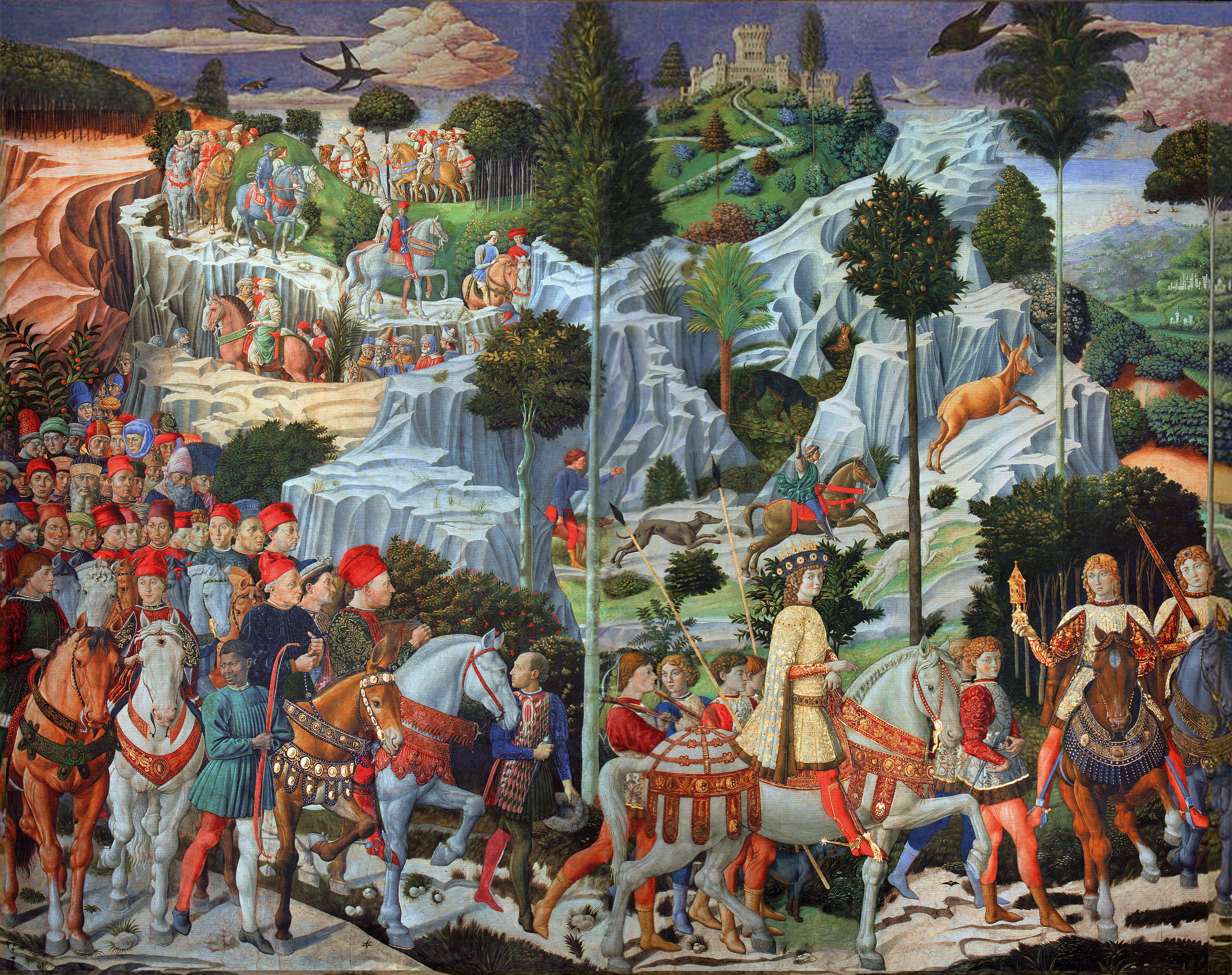
[Detail from Gozzoli's The Journey of the Magi courtesy of the
Wikimedia Commons]